U.S. airlines held earnings calls last week; they were interesting, with both the data and the words coming out of executives’ mouths. Delta seems to be focused on Asia, United on estate taxes, and American on the balance sheet.
Industry findings
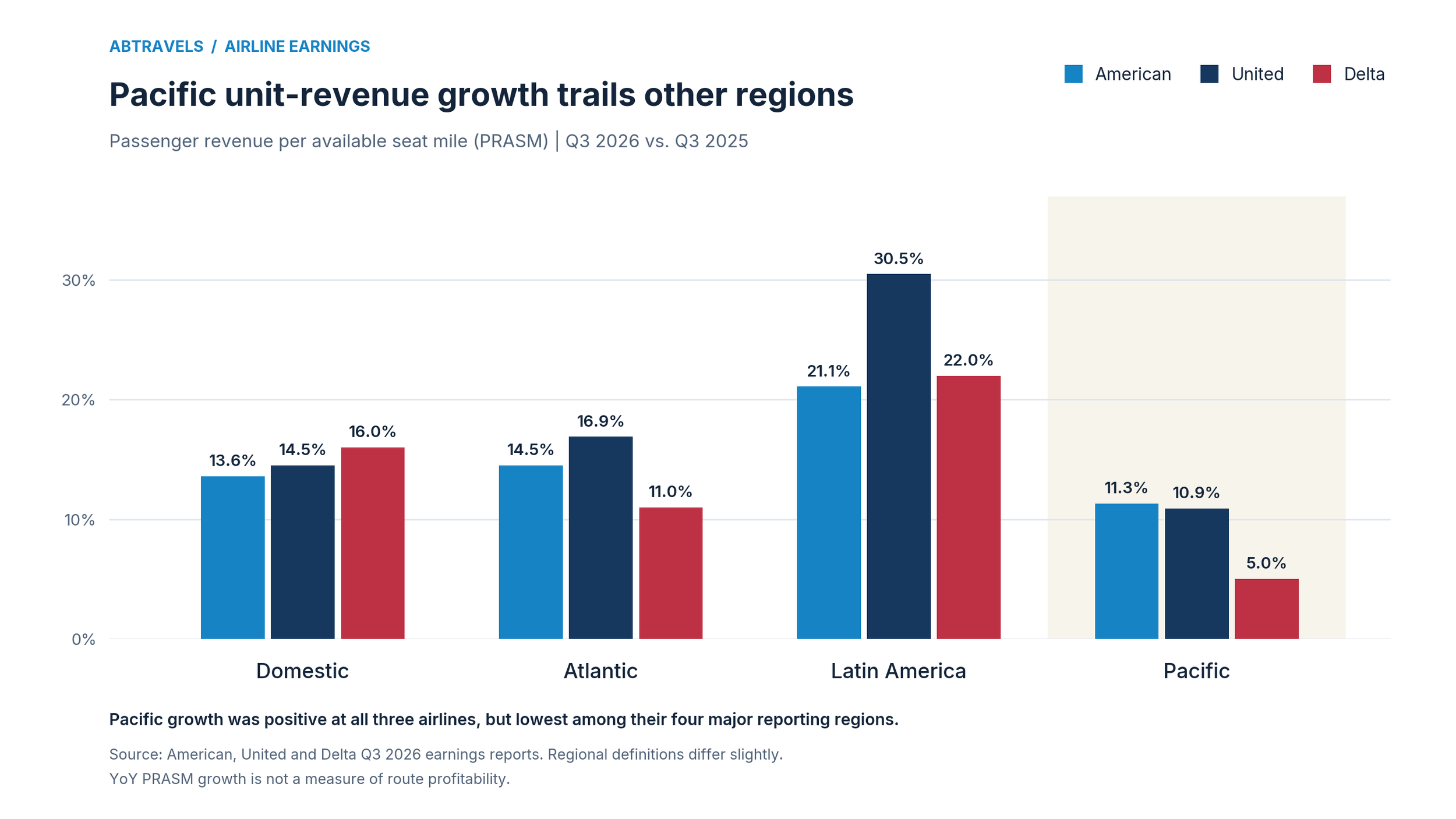
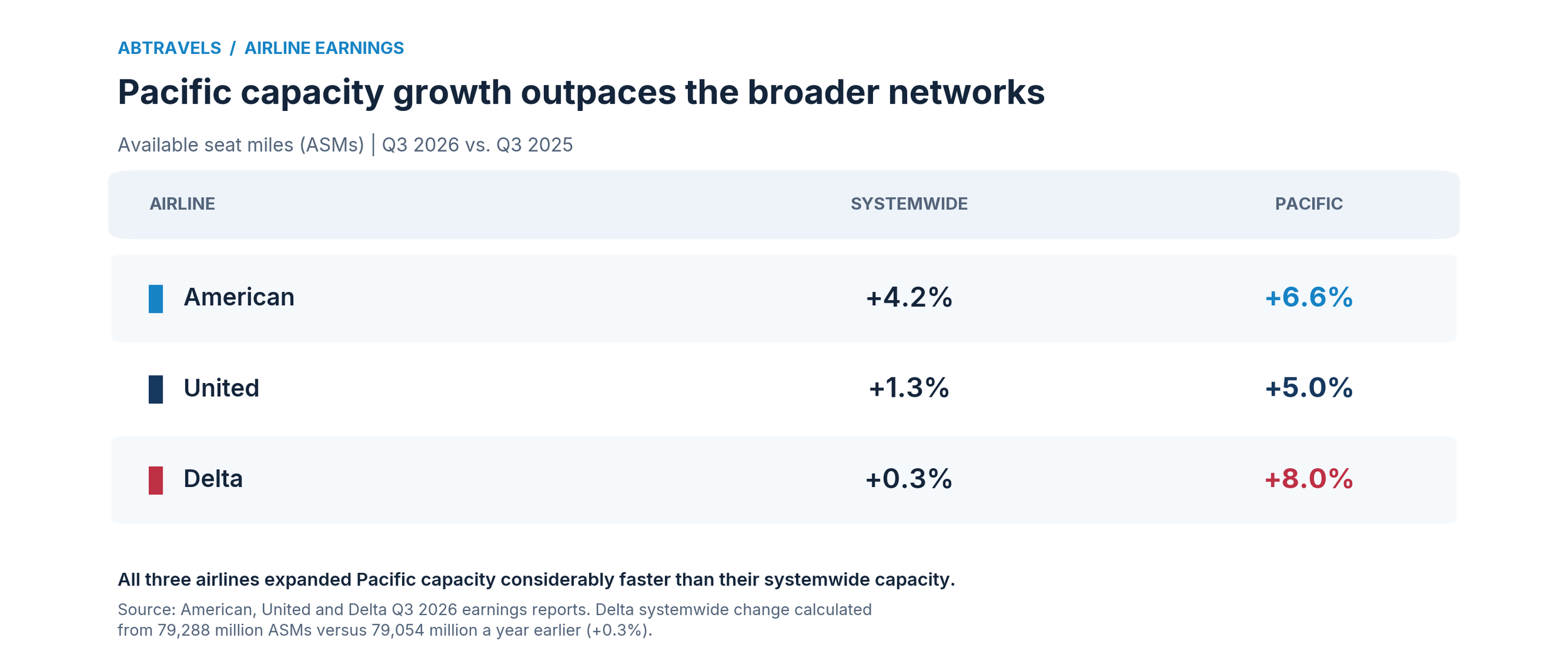
United up $1.03 billion, Delta up $756 million, American down $269 million, Southwest up $270 million, Alaska down $147 million. Surprisingly, Alaska led the industry in premium growth at 25%, followed by American at 22.9%, Delta at 18%, and United at 17%. Fuel costs are rising faster than fares, making airline strategy even more complex. Several carriers are limiting capacity growth to protect revenue per seat. For example, Southwest reduced its third-quarter capacity by 0.4% while achieving 21.6% growth in unit revenue. American also expects to slow network growth in 2027 because of elevated fuel prices. All airlines expect a +/-20% revenue increase, but most expect big losses due to global conflict. I had AI generate this graph on revenue per available seat mile by region and airline, as well as growth, which shows the problem. The Pacific had the slowest year-over-year passenger unit-revenue growth. Delta provides the clearest example. The airline expanded Pacific capacity by 8%, but passenger revenue per available seat mile increased only 5%. In contrast, its Latin American capacity declined 6%, while passenger unit revenue increased 22%. It’s surprising that Delta is rapidly adding Asia routes despite having the worst per-passenger-unit revenue growth. It seems airlines are accepting short-term low yields for better long-term profitability. It is known that U.S. airlines lack Pacific offerings since COVID due to fuel costs, U.S. China tensions, lower demand, and worse economics. As an analyst, I don't understand why airlines are adding more service when they are producing the worst revenue per seat-mile on those routes. Q3 earnings reveal a striking contradiction: American, Delta, and United each expanded Pacific capacity faster than in any other major region, yet the Pacific produced their weakest regional passenger unit-revenue growth. The figures raise questions about how quickly their Asian expansion strategies can deliver improved financial returns.
American is losing $269 million, while United makes $1 billion
This gap is very surprising on the balance sheet. American has struggled to make a profit since COVID, and over the past year has made several fixes to mistakes management previously made. This was long overdue, and they are finally looking forward with a premium vision where the balance sheet reflects high costs and high revenue, not cost-cutting to compete with Spirit and Frontier. They are adding premium seats to sell and offering a better product that customers want to fly, which United started doing years ago. American had operating revenue of $16.3 billion, while United had operating revenue of $ 17.9 billion. American reported a 22.9% increase in premium revenue and a 27.6% increase in managed corporate revenue. This is more than any competitor and is where the high-yield customers are. American reported a 3.0% increase in unit costs excluding fuel and certain other items, versus United's 7.8% increase. American isn't necessarily underperforming in every financial category. American leads the industry in additional services in this category at every destination except the Pacific, but it is still expanding, with more coming next year and a new service from Chicago to Tokyo this March. I do fear that American had only a 0.7% pretax operating margin, and its Pacific load factor fell 2.6 percentage points despite stronger fares.