Industry Leading BlogsHi! I’m a 16-year-old with big dreams and an even bigger passion for travel, aviation, and business. Welcome to my corner of the internet, a travel blog where I talk about my trips and what’s going on in travel.
My goal isn’t just to see the world, I want to understand how it moves. I’m especially fascinated by airlines, hotels, and the business side of travel. One day, I hope to run my own airline. This blog is part of that journey, a place to explore travel through my eyes while learning what makes the industry tick.
Whether you're a fellow teen traveler, future entrepreneur, or someone who just loves discovering new places, I’m glad you’re here. Let’s explore the world together, one city, one culture, and one flight at a time. Please join me on my journey by reading and sharing!
U.S. Airlines Financial Performance Is Out- United Up $1 Billion While American Is Down $270 Million- The Greater Meaning and What Comes Next
U.S. airlines held earnings calls last week; they were interesting, with both the data and the words coming out of executives’ mouths. Delta seems to be focused on Asia, United on estate taxes, and American on the balance sheet.
Industry findings
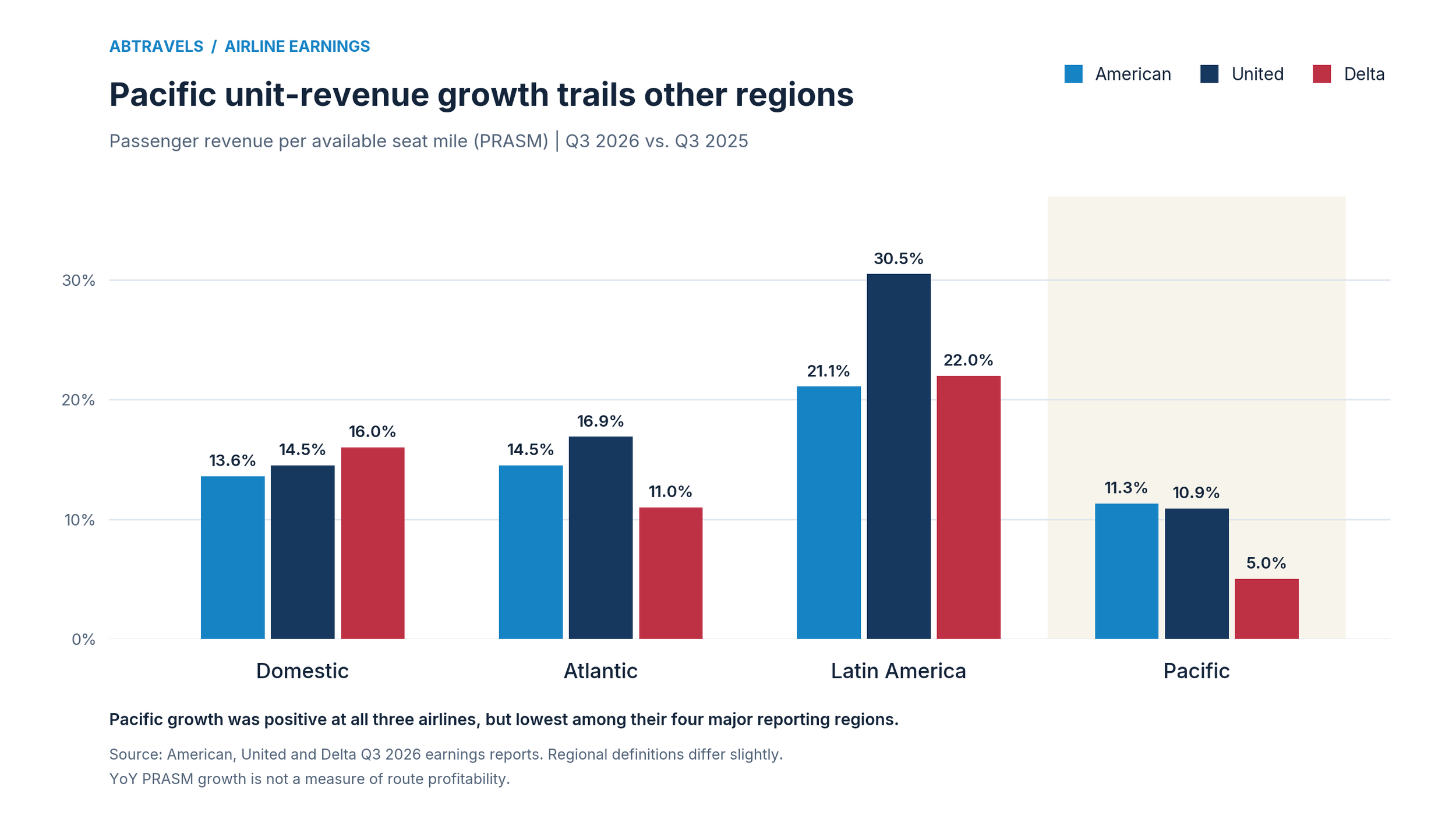
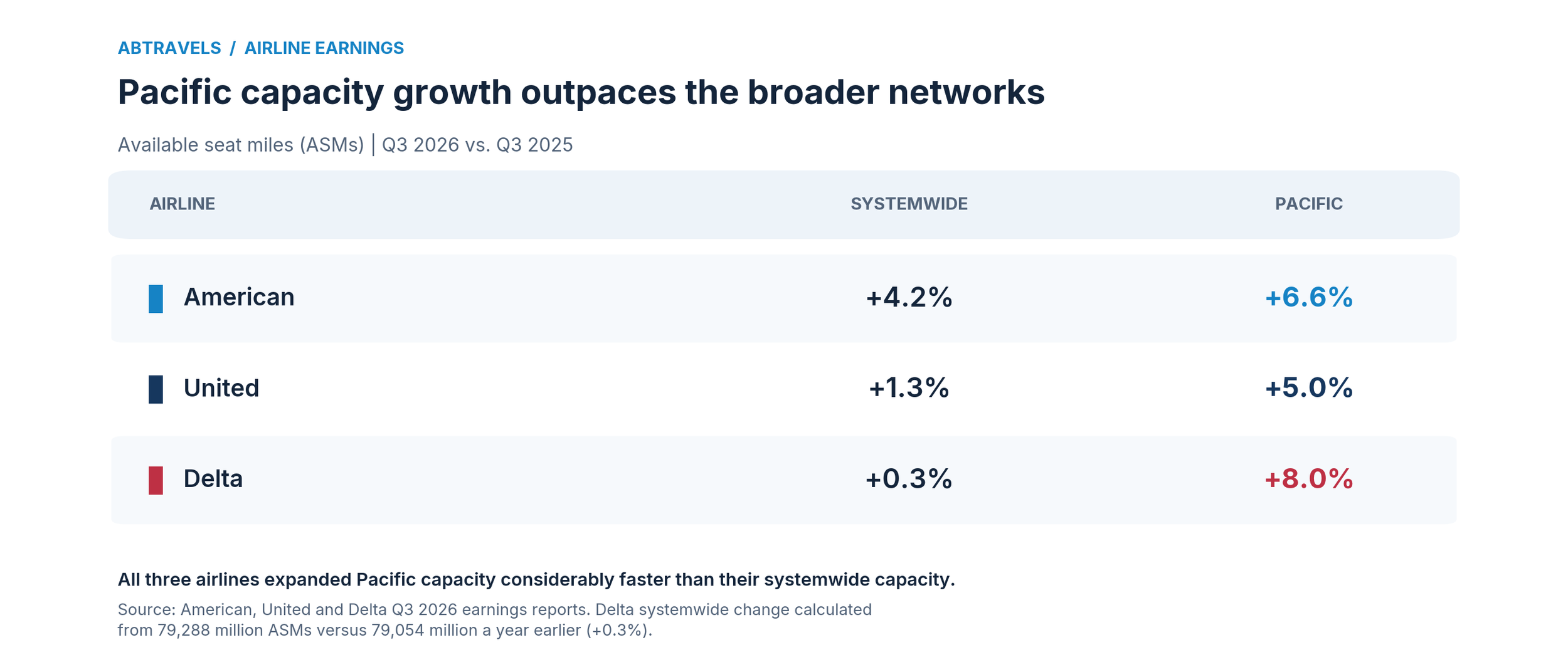
United up $1.03 billion, Delta up $756 million, American down $269 million, Southwest up $270 million, Alaska down $147 million. Surprisingly, Alaska led the industry in premium growth at 25%, followed by American at 22.9%, Delta at 18%, and United at 17%. Fuel costs are rising faster than fares, making airline strategy even more complex. Several carriers are limiting capacity growth to protect revenue per seat. For example, Southwest reduced its third-quarter capacity by 0.4% while achieving 21.6% growth in unit revenue. American also expects to slow network growth in 2027 because of elevated fuel prices. All airlines expect a +/-20% revenue increase, but most expect big losses due to global conflict. I had AI generate this graph on revenue per available seat mile by region and airline, as well as growth, which shows the problem. The Pacific had the slowest year-over-year passenger unit-revenue growth. Delta provides the clearest example. The airline expanded Pacific capacity by 8%, but passenger revenue per available seat mile increased only 5%. In contrast, its Latin American capacity declined 6%, while passenger unit revenue increased 22%. It’s surprising that Delta is rapidly adding Asia routes despite having the worst per-passenger-unit revenue growth. It seems airlines are accepting short-term low yields for better long-term profitability. It is known that U.S. airlines lack Pacific offerings since COVID due to fuel costs, U.S. China tensions, lower demand, and worse economics. As an analyst, I don't understand why airlines are adding more service when they are producing the worst revenue per seat-mile on those routes. Q3 earnings reveal a striking contradiction: American, Delta, and United each expanded Pacific capacity faster than in any other major region, yet the Pacific produced their weakest regional passenger unit-revenue growth. The figures raise questions about how quickly their Asian expansion strategies can deliver improved financial returns.
American is losing $269 million, while United makes $1 billion
This gap is very surprising on the balance sheet. American has struggled to make a profit since COVID, and over the past year has made several fixes to mistakes management previously made. This was long overdue, and they are finally looking forward with a premium vision where the balance sheet reflects high costs and high revenue, not cost-cutting to compete with Spirit and Frontier. They are adding premium seats to sell and offering a better product that customers want to fly, which United started doing years ago. American had operating revenue of $16.3 billion, while United had operating revenue of $ 17.9 billion. American reported a 22.9% increase in premium revenue and a 27.6% increase in managed corporate revenue. This is more than any competitor and is where the high-yield customers are. American reported a 3.0% increase in unit costs excluding fuel and certain other items, versus United's 7.8% increase. American isn't necessarily underperforming in every financial category. American leads the industry in additional services in this category at every destination except the Pacific, but it is still expanding, with more coming next year and a new service from Chicago to Tokyo this March. I do fear that American had only a 0.7% pretax operating margin, and its Pacific load factor fell 2.6 percentage points despite stronger fares.
American and Alaska Airlines Announce Customer Enhancements and Joint Venture Agreements
American Airlines allows Alaska Airlines to join its transatlantic and transpacific joint ventures. After American planned to fly long-haul routes from Seattle years ago and Alaska's short-haul connections ultimately failed, Alaska merged with Hawaiian. American is now fighting to strengthen the relationship through this, and the CEO previously hinted at still merging in April. Beyond merger potential, the deal means more trans-oceanic offerings for customers of both carriers, and American will start flying 2x daily from New York (JFK) to Seattle. For the airlines, it means more route possibilities because a failed route is shared rather than fully their own.
American has been making improvements beyond that. They are now adding Starlink Wi-Fi to their 787 and 777 aircraft, meaning faster, free Wi-Fi. They just announced points-and-cash booking for customers. They also announced that they have automatic seat changes- meaning if you want a further forward seat, you can set it up to automatically move you forward if available. They now have more complimentary snacks, including branded food like Goldfish. To supplement this, they improved Admirals Club food and opened Flagship First Dining to Business Class customers to Europe, Asia, South America, and the Middle East.
Alaska is really making moves. On their 25+ Boeing 737 MAX 10s on order, they are getting lie-flat seats. These aircraft will fly 4-7-hour routes, and high-paying customers at the front make up a large portion of the revenue. They are adding a business-class lounge to enhance the experience.
U.S. Airlines Speak About Asia Plans
U.S. based airlines Delta, American, and United Airlines are changing their Asia schedules. Since COVID, frequencies from the U.S. to Asia have dropped sharply. American and Delta have both announced plans to return to Singapore. Delta has announced routes to Manila, Hong Kong, Tokyo (NRT), and increased service to Seoul. American has announced increases to Tokyo, with more expansions coming once deliveries of its 787-9P aircraft are complete. United has been the dominant carrier in Asia since COVID and believes it will remain so. To try and manipulate analysts to block Delta from doing this, United's CEO, Scott Kirby, says that “We have the best Pacific hubs. We are 5x bigger than DAL in the Pacific. Markets DAL is opening in Pacific are low yield and half empty, like HKG. They don’t have the right aircraft for the Pacific. SFO is the best Pacific gateway to have. We’ll be #1 across both oceans.” United's CCO also claims, “The [UA] LA-HKG route is quite successful now as a result of [the BKK/SGN tags]. We face new competition now from another airline based in ATL, and I know they’re not going to do very well there. I can already tell from their pricing. They’re unable to fill up their airplanes.” United has a point about being the dominant carrier, but those statements aren’t necessarily true. United is known to make extreme statements that aren’t always accurate. Kirby claimed American was going to dehub Chicago; instead, they responded by increasing service. In the coming months, expect to see an increase in Asia services, primarily from American and Delta.
Airline Executives Warn About Capacity Decreases and Fares Increasing
Last week, United, American, and Southwest warned analysts that fuel prices continue to rise. Executives warned that potential outcomes include higher fares and supplements (baggage, seat selection, etc.) and reduced capacity. Fuel Prices are up 80%, and airlines are struggling to meet profitability. To cut costs, airlines have focused on eliminating transcontinental routes. (Ex: LA to Pittsburgh, Cincinnati). In addition, fares are up 25% year over year. Expect this to continue until fuel prices drop, given tensions with Iran and the Strait of Hormuz being closed.
American and United Airlines to fly new European Routes Next Summer
American and United Airlines to now fly new routes on board their airbus A321XLR. Both airlines are taking delivery of the aircraft this year. This serves a unique purpose for U.S. carriers: it is a narrow body aircraft with a long range, premium configuration, and low operating costs. American is using the XLR on transcontinental routes(EX:JFK-LAX/SFO), winter capacity reductions, and summer seasonal routes including New York to Amsterdam and Nice; Philadelphia to Porto, Vienna, Reykjavic, and Vienna. United will be using them for winter capacity reductions as well as from Newark: Valencia, Ibiza, Marseille, Luxomberg and from Dulles to Toulouse. United also used this as an opportunity to announce service from Newark to Terceira, Catania, Olbia, Ljubljana. All of these routes are very strategically used for these airlines. They are premium heavy for high paying liesure travelers on these summer seasonal services and also for taking over high yield routes in off season like JFK-BCN. Airlines can offer nonstop routes to smaller destinations(like they are) that are long distance at profitable results. Both Airlines have dozens more XLR’s incoming and this is where future expansions will be.
American Airlines To Reinstall In-Flight-Entertainment Screens On Narrowbody Jets
American Airlines will be retrofitting much of its fleet. They’ve announced “More storage, redesigned seats, and enhanced lighting will have customers flying in comfort and style.” This is driven by the company’s customer experience push this past year. The company removed the screens in 2014 to cut costs, but now has made it a priority with 2028 starting retrofits. The strong-spoken CCO Nat Pieper "Whether it's onboard food, seats, lounges, Wi-Fi ... those are the kinds of investments that make sense and really, kind of, put a halo around where American is trying to go," American is supplementing this with more premium seats on its A321 and 737 Max 10 aircraft; this includes main cabin extra and domestic first-class seats. The airline is really pushing a premium image.
Delta Airlines To Fly Austin to Paris
Delta Airlines bets even heavier on Austin. This is the first long-haul route from Austin offered by any U.S. carrier and continues to show their dominance at the city. The route will be operated by Delta’s A330-900NEO aircraft, offerring 224 coach, 28 premium economy, and 29m business class seats. This route has timed conections to joint venture partner Air-Frances routes. Popular connections include Nice, marseille, Barcelona, Rome, Madrid, Lisbon, Florence, Copenhaven, Geneva, Zurich, and Milan. This route is likely to not be very profitable for Delta, but is flown in attempt to get credit card customers where the credit card revenue increase is projected to outweigh the route costs. Delta already has a strong market share and has won a chunk of market share from American and this will just continue that.
American Airlines Reshapes Management - What This Means
American Airlines Reshapes Management - What This Means
American Airlines has some changes coming to its management. The following changes are incoming:
CSO, Steve Johnson, is entering retirement - nothing new, this was announced months ago.
Executive Vice President of American Eagle, corporate real estate, and government affairs, Nate Gatten, is moving to Apple for a better job.
Executive Vice President of communications and marketing and chief communications officer, Ron DeFeo, is leaving in March.
Senior Vice President of tech ops, Kevin Brickner, is retiring after a 30-year tenure.
What this means is very complex, but the basics are that people who should be in charge and seem to have a proper vision are getting more power. Chief Commercial Officer, Nat Pieper, is adding marketing, brand, advertising, and partnerships as responsibilities. This changes indirectly how customer experience budgeting will work. Chief Customer Officer, Heather Garboden, will only report to Nat Pieper; Nat Pieper has advertised a premium experience for customers as his image, allowing Garboden to accomplish more.
Former Spirit Chief Operating Officer John Bendoraitis joins American to lead technical operations. This should help American Airlines’ competitively unreliable arrival accuracy rate. Chief People Officer Cole Brown’s HR organization adds employee recognition and engagement; this should help one of the company’s weak spots. There are many other changes, but nothing else should make a difference for consumers.
To summarize, these changes are great for American Airlines as they attempt to get competitively stronger. Management seems to be moving in the right direction.
Delta Airlines To Fly Seattle to Tokyo Narita- What This Means
Delta Airlines will commence daily flights from Seattle to Tokyo Narita on an Airbus A330-900NEO effective March of this year. This addition complements their existing service from Seattle to Tokyo Haneda, the more popular and preferred airport in the city. The current service will remain unaffected. For Delta, service to Narita holds strategic significance beyond being an additional route; it represents a sustained effort to establish dominance in Seattle against competitor Alaska, which recently announced a Seattle-Narita route. Despite being the least profitable hub for any U.S. airline, Delta is determined to maintain its West Coast presence and prevent competitors from gaining control over the Asia markets. Delta’s unprofitability was revealed by analyst One Mile At A Time, who reported, “When you crunch the numbers with that methodology, the single least profitable hub of any major US airline is Delta’s hub in Seattle. Only 5% of the carrier’s routes out of the airport aren’t in the bottom 40% of the carrier’s network in terms of revenue per available seat mile. Apparently the hub has been performing very poorly for years now, but it seems the situation is getting even worse. A year ago, 7% of routes weren’t in the bottom 40% of Delta’s routes, while now that number is down to just 5%.”
United Airlines Bet’s on Premium Demand in Houston
United Airlines to fly their premium-heavy configuration 787-9s to more destinations starting this October. Internal sources have leaked that the carrier will offer at least four daily flights from Houston on-board these aircraft: to London, Sao Paulo, Tokyo (NRT), and Sydney. This announcement comes with a 30% increase in premium seats on those routes including 99 business/premium economy seats and a 35% decrease in economy seats from current offerings on those routes. 45% of the seats on the reconfigured 787-9 are premium economy or business class, where the other configuration is 27%. This data indicates a common pattern for these types of destinations: a decrease in coach demand and a shift to premium-heavy offerings. United’s bet on premium offerings dictates the demand increase for passengers willing to pay for upgrades and an elevated experience. This is an expansion beyond the initial West Coast launch from San Francisco to Singapore and London, and Sydney is particularly significant since these are among United's longest nonstop services, which is exactly the kind of route where a premium cabin overhaul matters most. Furthermore, this came as a surprise because United’s first premium 787-9 aircraft had maintenance problems and was pulled from service within a month of operation.
Delta Airlines to fly to Manila- The Fight for Los Angeles Continues; New Routes Leaked
Delta Airlines, an Atlanta-based carrier, announces new nonstop flights from Los Angeles to Manila. This is the second flight offered by U.S. carriers to Manila: United Airlines’ nonstop service from San Francisco. Daily services will be flown on an Airbus A350. This is another testament to my previous statements about Delta trying to win Los Angeles: American can’t win due to construction, and United couldn’t justify service from LAX because of its SFO hub. Internal memos say that Delta will be flying from LAX to Washington DC(IAD), Singapore(SIN), and Seoul(ICN) next, and this competitive push is just the beginning of what’s getting announced this quarter.
Delta To Roll Out New Pricing System
Delta AIrlines, an Atlanta-based carrier, announces a new pricing strategy. The airline will now offer a restricted fare in the premium cabins. Similar to their basic economy, there will be limited mileage accrual, no seat selection, a reduced baggage allowance, no lounge access, and a cancellation fee applies. This is targeted at passengers who care about the seat, not the experience. This follows competitor, United Airlines recent changes in an attempt to fill premium seats with more revenue passengers rather than upgrading passengers.
American Airlines To Fly Chicago to Tokyo and 3 European Destinations
American Airlines, A Fort-Worth-based carrier, announces service from Chicago O’Hare to Tokyo Narita. This route came expected as the airline fights for makret share in Chicago, and competitor United Airlines adds that route in addition to their daily service at Tokyo Haneda. American will fly their coach-heavy layout 787-9 aircraft.
American has the route timed connections on their joint venture partner Japan Airlines to Bangkok (BKK); Singapore (SIN); Taipei (TPE); Ho Chi Minh City, Vietnam (SGN); Manila (MNL): Osaka (ITM); and more. Japan Airlines already flies the route, with timed connections in ORD from the east coast and southern cities (ex: St. Louis, Miami, Kansas City, Richmond, Fort Myers, Atlanta, Memphis, Tampa, etc). American has had successful results from Dallas to Narita, and with competitve tensions in Chicago figured to move some connetions to Chicago to justify competition with demand. American struggled to rebuild their Chicago hub since covid; consequently, competitor United Airlines went all in on Chicago. American became the non-dominant carrier. Following pressure from the public and board, they have been competing to recover market share in what is arguably the most important market. American has added over 30 routes and in the coming couple months will announce more long-haul services. Expect to see 3 more long-haul services to Europe next summer from Chicago using 787 aircraft and at least one to replace a Philadelphia route. Probable destinations can include Prague, Budapest, Amsterdam, Milan, Zurich, Sao Paulo, Munich, Frankfurt, Lisbon, and Warsaw. My bet: Lisbon, Warsaw, and Prague or Budapest.
Delta Airlines To Fly Los Angeles To Newark, Why This Is So Complex
Delta Airlines, an Atlanta based carrier, to fly twice daily from Los Angeles to Newark, New Jersey. This came interestingly granted that Delta already flies to New York JFK up to ten times daily. Delta must view Newark as a big destination; they are flying the route twice daily, thats 88 business class recliners in each direction. Competitor United Airlines flies this route ten times a day, but that is a different circumsrtance; Newark is Uniteds trans-atlantic hub and will have connecting passengers. Just like Delta’s flight from Los Angeles to New York. Delta makes $449 million yearly on that route. The odds are that number will go down because some of their JFK customers will fly from Newark for convneience. Delta is filling the flight with Newark being a destination that connects to Los Angeles and their recently expanded trans-pacific network.
What also makes this interesting is that Delta won’t be competitive at Newark and this route is fully directed at Los Angeles. Delta is expanding service in Los Angeles with intentions of winning all the business and credit card spenders through more routes and nicer lounges. Delta is looking for any media it can get in Los Angeles as it targets to drive United out. Expect a punch back from United and expansions from Delta and United, and maybe so American in Los Angeles.
JetBlue to continue reducing operations at New York for Fort Lauderdale
Low-cost airline JetBlue has made some operational adjustments. Following their executives’ warnings of bankruptcy, they are reducing costs and focusing on the market share they can win in the short term. This is done by shifting from high-cost airports such as New York and Boston to lower-cost airports such as Fort Lauderdale. Following Spirits' bankruptcy, there is a lot of claimable market share in South Florida. Spirit dominated at Fort Lauderdale; therefore, there are more customers to gain, which leads to more credit card revenue. Additionally, they are closing their Tech Op bases at Newark and LaGuardia, as well as their Newark flight attendant base. This is also strategic because they have slots to sell at LaGuardia without losing government subsidies for the year. Fort Lauderdale for JetBlue has much more short-term opportunity, given the strong potential demand from Spirit’s departure and the lack of competitors with a base there. Expect a departure from JFK next because they have 360 slots to sell that American, Delta, and United would likely buy. America competitively needs JFK and should be focusing on scaling there, and United’s CEO, Scott Kirby, has talked about wanting to expand their presence; these slots are very likely on the table. JetBlue needs to just stay in business; furthermore, they just want to reduce their debt and stay in business.
Delta Airlines Announces Competitive Plan To Win Los Angeles
Delta Airlines, an Atlanta-based carrier, is strategizing a long-haul competition at Los Angeles. They are building a second Delta One Lounge for customers flying in international business class, expanding service to Shanghai and Auckland, and planning a service to Seoul and Manila. Operations from Los Angeles are historically a struggle for airlines due to high operating costs. They already have the most flights and seats from Los Angeles; this should increase their competitive market share with customers and drive Amex card spend. They beat American for New York, and United was driven out, and they have a majority market share in Boston, Austin and Atlanta, which is huge and if they can take LA, they have access to a large credit card revenue increase.
American Airlines Adds Dining Menu At Lounges
Dallas-based American Airlines announces enhancements to its Admirals and Flagship lounges. Following the alcohol upgrades and all the new lounges being built, this is great to see. The Airline has really focused on the premium product and experience; it shows. Furthermore, they offer better lounges than competitors. Although this is nice to see, the airline has other problems they need to focus on that matter more; they lack reliability, in-flight wifi quality, and in-flight dining. I find these to likely be their focus; they have put an emphasis on investing in the customer lately and hired a customer experience team in the past year.
Delta Airlines To Cancel Lie Flat Seating On Transcontinental Routes
Delta Air Lines, an Atlanta-based carrier, decided not to proceed with its Safran Vue seats on its new Airbus A321NEO aircraft. This aircraft is used on premium heavy routes with many business travelers. This is a problem for Delta because its profits come from being the most premium airline for business travelers and from its credit card spend. Delta now lags American and United in premium product for their transcontinental routes. These flights are key to airline profits, with destinations including the following cities: Phoenix, Los Angeles, San Faransisco, Orange County, San Diego, Salt Lake City, and Seattle, to Miami, Orlando, Atlanta, Boston, New York, Philadelphia, Washington, DC, etc. New York and Los Angeles are the largest credit card markets; therefore, this will likely be a profitability problem. Flights between California and the East Coast are among the most profitable routes because of the premium-ticket opportunity, and the older aircraft Delta uses aren’t equipped with competitive, up-to-date seats. Additionally, the older planes do not have enough premium seats to sell. Even if this gets fixed, it will take years to catch up and get those aircraft allowed to operate. Delta has been lagging in its investments in customer experience; the CEO Ed Bastian is famous for promoting “the customer comes first” and investing in the customer. Delta cheaped out on Amazon Wi-Fi over Starlink, cutting food and beverages in-flight, and struggling with operational performance where it matters, with internal memos leaked pointing it out. (link below). If Delta continues its cost-cutting, it will likely face profitability problems due to a decrease in premium and credit card revenue, just as American Airlines did, and it has been fighting for years to regain market share.
learn more about the profitability of these routes at https://www.bts.gov/topics/airlines-and-airports/origin-and-destination-survey-data
American Airlines Announces Starlink Wi-Fi On Board
American Airlines Announces Starlink Wi-Fi On Board
American Airlines, a Fort Worth-based carrier, announces a new partnership with Starlink for onboard Wi-Fi across over 500 aircraft. American plans to upgrade its Starlink Wi-Fi on over 500 mainline aircraft. This will likely be all of their Airbus aircraft. This includes A319, A320, and A321 family aircraft. The operation is scheduled to be complete for Q1, 2027. What I don’t understand is why this seems to go to these aircraft but not to their Boeing 737 aircraft, which are the root of their Chicago hub, one of their most competitive markets.
This is still a huge customer experience expansion. The airline has continued to invest in the customer experience following a lag in profitability relative to competitors, but both its long-haul aircraft and the Boeing 737 family should also be upgraded.
Competitionally speaking, this is a big win for American. This falls short of United, which upgraded Starlink across its whole fleet, but it beats Delta, which also only put a Wi-Fi upgrade on some of its fleet and used Amazon instead of Starlink to cut costs. Many airlines have announced. These airlines have already announced Starlink: IAG airlines (e.g. Aer Lingus, British Airways, Iberia); Lufthansa Group airlines (e.g. Lufthansa, SWISS, Austrian Airlines, Brussels Airlines, ITA Airways); Hanjin Group carriers (Korean Air, Asiana Airlines, Jin Air, Air Busan, Air Seoul); airBaltic, Air France, Air New Zealand, Alaska Airlines; Emirates; flydubai; Gulf Air; Qatar Airways; SAS; Virgin Atlantic; Southwest Airlines; WestJet; ZIPAIR. From a competitive standpoint for global U.S. airlines, American is catching up to United and Delta through increased reliability and customer investment. Delta is slipping due to cost cuts on Starlink, decreased reliability, and the use of older aircraft on long routes, which are starting to show their age. United’s CEO Scott Kirby’s remarks about there being two global airlines, United and Delta, but I would question if American is starting to offer a better experience than Delta and has more strategic partnerships. American has invested and improved so much in the past year.
United Airlines to enhance JetBlue partnership and new flights to Japan, JetBlue to fly to Milan
United Airlines, a Chicago-based carrier, announces new global network enhancements and a reciprocal benefits agreement with JetBlue. Benefits include seat selection, boarding, baggage, and standby priorities.
United will now fly nonstop from Chicago O’Hare (ORD) to Tokyo Narita(NRT) daily on their 787-10 aircraft. This is United’s second nonstop to Tokyo from Chicago, but the first to Narita. The goal for this route is not because their is demand for a second flight to Tokyo, but United see’s the demand of connecting people to their mini hub operation at Narita where they have connecting flights from the U.S. to Cebu, Philippines (CEB), Kaohsiung, Taiwan (KHH), Ulaanbaatar, Mongolia (UBN) Koror, Palau (ROR), and Saipan (SPN). United has a huge competitive advantage in the demand of American customers because Americans like flying American carriers, and United is the only carrier that offers that. Customers will pay a premium for American carriers, and United, being the only one in that market, will be able to charge high fares.
Starting December 11, United will launch three times weekly winter seasonal service between San Francisco (SFO) and Sapporo (CTS), marking the first nonstop flights between the continental U.S. and Sapporo. Sapporo is popular for tourism and skiing, a snow festival, and world-renowned cuisine. United now offers service to four Japanese airports compared to their competitors’ two. Again, being the only carrier in a market allows it to charge high fares, which is a major profitability driver.
The United and JetBlue partnership, called Blue Sky, is growing rapidly. United now offers reciprocal benefits for frequent fliers, minus upgrades and lounges. This partnership was established less than a year ago; for non-alliance partnerships to expand this quickly is rare. These benefits will be helpful for frequent fliers’ journeys, with reciprocal benefits including complimentary seat selection, priority boarding, complimentary and priority baggage, and standby priorities. Forward-looking, this could be a hint at an incoming merger. Although the Department of Transportation denied JetBlue and American's merger, United has been donating millions to the Department and will be more likely to succeed, though it's not very likely. My theory is that United claimed potential mergers with American Airlines as a cover-up to make the government allow JetBlue to merge with United.
JetBlue announces a new flight from Boston to Milan daily for the coming summer. fares are available starting at $399 in core, $649 in EvenMore and $2199 in Mint for Boston-originating travelers, and from €449 in core, €659 in EvenMore and €1799 in Mint for Milan-originating travelers. JetBlue is the only carrier with the new service.